The Scent of Mint and Roses - life in a garden in the making

"Ajan pysäyttäminen ei ole puutarhan idea, vaan kaiken aikaa eteenpäin virtaavista ja muuttuvista, varsin välähdysmäisistä hetkistä nauttiminen." (Mari Mörö: Melkein kaikki itää - puutarhaa pihan täydeltä)
"Garden is not about pausing time but enjoying the constantly forward flowing transient moments."

Tervetuloa aloittelevan bloggaajan ja kotipuutarhurin maailmaan! Welcome to a beginner blogger and amateur gardener's world!

keskiviikko 22. elokuuta 2012

Pensasruusuja - Shrub roses

Olen erityisen viehtynyt pensasruusuihin ja kerännyt niitä jo jonkinlaisen kokoelman. Juhannusruusu Rosa spinosissima 'Plena' on kotoisin mieheni lapsuudenkodista Vantaan Kuninkaanmäestä. Se on meillä kituuttanut vuosia kuivassa paikassa, mutta nyt kun se sai ympärilleen uuden istutusalueen ja muita kasveja, se on lähtenyt uuteen kasvuun. Tänä kesänä kukkaloisto oli hurmaava ja kukintakin ajoittui viileän alkukesän ansiosta juuri juhannukseksi. I am particularly enchanted with shrub roses and have amassed a bit of a collection. In the picture above, the Burnet Rose 'Plena' comes from my husband's childhood home. It flowers only once with deeply fragrant butter-colored blooms. It has barely survived in my garden, but now that I built a bigger bed with several other shrubs around it, it has started to thrive. In Finnish its name is the Midsummer Rose because traditionally it has flowered over Midsummer, and this year the blossom was spot on thanks to the cool weather in early summer.

Sammalruusu Rosa centifolia muscosa -ryhmä 'Vaarala'. This is an old Finnish Moss Rose from the Centifolia muscosa group called 'Vaarala'.

Kartanoruusu Rosa centifolia-ryhmä 'Tähtitorninkatu'. Kaunis, lamoavaoksainen ja tuoksuva helmi. This is a Cabbage Rose from the Centifolia group called 'Tähtitorninkatu'. It is an old Finnish rose found from a property in the City of Helsinki on the street called Tähtitorninkatu, thus, the name. It is perhaps my favorite rose with its relaxed branches and, of course, an irresistible scent.

Tarhakurtturuusuja eli rugosa-ryhmän edustajia löytyy puutarhastani eniten. Tässä kaunis 'Snow Pavement'.  Rugosa Roses are sturdy suckering shrubs, and I have quite a few of them. Here is the beautiful variety 'Snow Pavement'.
Tässä ihanantuoksuinen, haaleankeltainen tarhakurtturuusu Rosa rugosa 'Agnes'. Muita tarhakurtturuusuja puutarhassani ovat teresanruusu 'Thérèse Bugnet', 'Moje Hammarberg', 'Pink Pavement', 'Hansa' ja Pirjo Raution risteytys 'Sassa Natalia'. This is a lovely scented, butter-colored Rugosa Rose called 'Agnes'. Other Rugosas in my garden are the delicate 'Thérèse Bugnet', shrubby 'Moje Hammarberg', sturdy 'Pink Pavement', tall 'Hansa' and a hybrid by Ms. Pirjo Rautio, a Finnish rose expert, called 'Sassa Natalia'.

Ranskanruusu Rosa gallica -ryhmän kirjoapteekkarinruusu 'Rosa Mundi'. Toinen ranskanruusuni on historiaa haviseva 'La Petite Orléanaise'. This is a variegated rose from the Gallica group called 'Versicolor' or 'Rosa Mundi'. It is a fmous old garden rose and a sport of the red Apothecary's Rose. Another one of my historical Gallica Roses is called 'La Petite Orléanaise'.
Remontoiva eli uudelleen kukkiva neilikkaruusu 'F.J. Grootendorst'. Periaatteeni on ollut hankkia vain tuoksuvia ruusuja, mutta tämä on yksi poikkeuksista. This is a repeat-flowering 'F.J. Grootendorst' the flowers of which remind carnations. My principle has been to plant only fragrant roses but with the Grootendorst I've made an exception. It is quite spectacular when it blooms all the way until the end of summer.

Tuoksuvien ruusujen aatelia, kesädamaskonruusu viehättävä Rosa damascena 'Mme Hardy'. I consider this one of the best fragrant roses. It is the lovely, old Damask Rose 'Mme Hardy'.

Puutarhani ruusukujalla köynnöstää suomenköynnösruusu 'Pohjantähti', yllä kuvassa oleva 'New Dawn' ja Rosa kordesii -ryhmän 'John Davis'. Yksi kauneimmista tämän kesän kukkijoista oli Rosa alba -ryhmän neidonruusu 'Maiden's Blush'. Harmi ettei se tallentunut kameraan. I have planted three Climbing Roses in the rose archway. There are the Finnish heavily-prickled 'Pohjantähti' with little plain flowers, 'New Dawn' seen in the picture above, and the Canadian 'John Davis' from the Kordesii group. And last but surely not least, one of the most beautiful sights this summer was undoubtedly the old garden rose 'Maiden's Blush' from the Alba group. Unfortunately I didn't get a good photo.

Samettikukkia - French marigolds


Ryhmäsamettikukkia reunustamassa hyötykasvitarhaa: lajikkeet 'Cat's Eyes', 'Legion Of Honour' ja 'Red Brocade'. Several varietes of French Marigolds bordering my kitchen garden. Here are the varieties 'Cat's Eyes' with their crested yellow centers and maroon petals, more than 150 years old 'Legion Of Honour' with yellow petals, and 'Red Brocade' with mahogany-red and yellow flowers.


Samettikukat pärjäävät hyvin puuvajan paahteisella eteläseinustalla. The French Marigolds thrive on the hot south-facing wall of our wood shed.


Kylvöistäni kehittyi yksi tällainen upea ilmestys. Kukka on halkaisijaltaan noin kuusi senttiä eli varsin kookas. Liekö eksynyt siemen väärään pussiin. Aion kerätä siemeniä talteen ja odottaa taas ensi kesänä tätä valloittavaa näkyä. My sowings produced this astonishing sight. The flowers were exceptionally large, approximately six centimeters wide. I guess the seed had been accidentally placed in the wrong bag. I was so keen with this sight that I am going to collect the seeds and see what comes of them next year.

Purkutiilistä muuri amppelitomaateille - A brick wall for tumbler tomatoes

Kesäkuussa puutarhaan valmistui purkutiilistä muuri amppelitomaateille. Kasvatan jo toista vuotta peräkkäin Tumbler-amppelitomaattia, sillä olen todennut sen erinomaisen satoisaksi ja hyvänmakuiseksi lajikkeeksi. Minulla on kaikkiaan kuusi tainta kolmessa altakastelevassa parvekelaatikossa. Istuttaessani taimet laitan pohjalle reilun varastoannoksen kanankakkaa, ja sitten kesä-heinäkuussa lisäilen erityisesti tomaateille tarkoitettua lannoitetta. Muurin lämpö toivottavasti auttaa satoa kypsymään ennen kylmien tuloa. In June we finished this wall from recycled bricks for hanging tomatoes. This is my second season growing the tomato variety called 'Tumbler' because I've found that it produces numerous tasty fruits in our conditions. I have altogether six plants in three long self-watering containers. When planting the plants, I add a good handful of chicken manure in the compost. Then in June-July I add a dose of bio-fertilizer made especially for tomatoes. The heat absorbed in the brick wall hopefully helps the fruits to ripen because the growing season in Finland is far too short.

Kasvihuoneessa minulla on tänä vuonna Sungold-kirsikkatomaattia kuusi tainta. Ensimmäiset tomaatit ovat kypsyneet, joten maistettu on. Sungold on erityisen makea - erään lähteen mukaan maailman makeimmaksikin mainittu - ja jää kypsyessään oranssiksi eikä muutu aivan tomaatinpunaiseksi. Hedelmän koko on vähän pienempi kuin Tumblerissa. Olen kokeillut myös kirsikkatomaattilajiketta 100s&1000s. Tomaatteja tosiaan tuli hurja määrä, mutta Sungold on niistä kahdesta suosikkini. In the greenhouse I am this year growing six plants of cherry tomatoes of the variety 'Sungold'. The first fruits have already ripened. The fruit is exceptionally sweet - by some source even the world's sweetest - and remains paler than the regular redish orange colour of tomatoes. The fruit is a bit smaller than in the Tumbler. In previous years I have also grown the cherry tomato '100s&1000s' but 'Sungold' is my absolute favourite.

Betoni on kaunista - Concrete can be beautiful

Betonipilari on tehty käyttämällä muottina sadevesiputkea, jonka sisälle on pantu kuminen kynnysmatto, jolla saa aikaan näyttäviä kuvioita. Putki on sahattu sivulta auki, jotta sen poistaminen on helpompaa. Valamisvaiheessa putki kiristetään liinoilla, ettei betoni pääsee karkaamaan muotista. We've made the concrete pillar by using a drainage pipe with an ornated rubber doormat inside as the mold. The pipe was sawn open from the side to help remove the mold. When pouring the concrete, the pipe was supported with ropes to prevent the concrete from escaping the mold.

Ruukku on tehty muovista, jalallista puutarharuukkua muottina käyttäen. Tämä oli ensimmäinen harjoitelma, jonka jalka ei onnistunut vaan murtui. Niinpä se on nyt jalaton. We made this concrete flower pot by using a plastic plant container as the mold. The container had a leg but this was our first experiment and the leg broke off. So now we are using the pot without the leg.


Muottina on käytetty jalallista puutarharuukkua. Tällä kertaa jalka säilyi ehjänä ja pysyi kiinni ruukussa vaikkakin hädin tuskin. Pilarin muotti on tehty vanerilevyistä. This plant container was made by using the same plastic container as in the above picture. This time the leg stayed intact, even though barely. The plain pillar was made with a mold built from plywood.

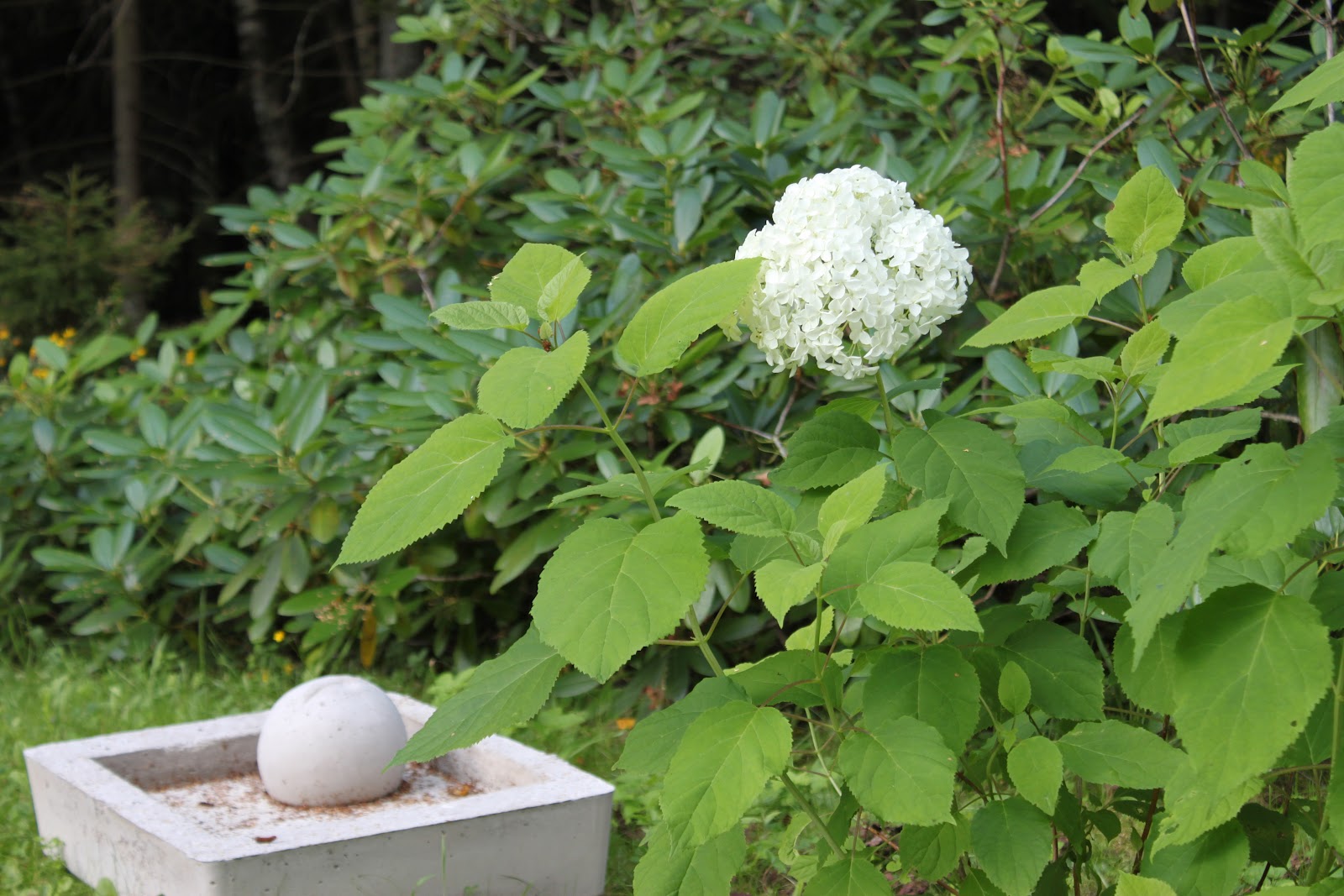
Vesialtaan muottina on käytetty muovista laatikkoa. Sisäosa saatiin tehtyä puumuotilla, jonka poistaminen osoittautui kuitenkin hankalaksi. Palasina se kuitenkin saatiin irrotettua. Pallossa on käytetty muottina muovista lastenpalloa. In this water feature (here without the water:) we used a plastic box as the mold. The inside was made with a wood block but its removal proved to be rather difficult. The ball was made by using a kids' plastic ball as the mold.

Lintujen kylpyallas on tehty käyttämällä muottina isoa laastisankoa. Jalassa muottina on käytetty sadevesiputkea. This bird bath was our first experiment with concrete. The upper part was made by using a big plaster bail as the mold. The leg was made with a drainage pipe as the mold.

Raparperikulho on tehty hiekkakummun päällä. Hiekka muotoillaan keoksi, jonka päälle raparperinlehti asetellaan. Sen päälle painellaan betoni. This rhubarb leaf bowl was made on top of a small sand pile. The leaf is put on top of the sand pile and the concrete is laid on the leaf by hand.

Tuikkualusta on tehty muovista karkkilaatikkoa muottina käyttäen. Tuikut ja koristehelmet on sitten painettu betoniin. Tuikkuja on hyvä pyöritellä ja liikutella aika ajoin kuivumisen aikana, että kolot pysyvät riittävän väljinä. This tealight holder was made by using a plastic candy box as the mold. The tealights and the glass gems were pressed on the concrete. It is good to wiggle the tealights every now and then when the concrete is drying so that the holes stay wide enough.

Puutarhassamme siis tehdään kaikenlaista betonista. Mökin rakentamisen yhteydessä hankimme betonimyllyn, joka edelleen runksuttaa iloisesti moneen otteeseen kesän aikana. Tehtailemme varsinkin raparperinlehtilaattoja, joita on hyvä tehdä aina, jos betonia meinaa jäädä tähteeksi jostain projektista. Lehti asetellaan tasaiselle alustalle, ja päälle taputellaan noin kolmen sentin kerros betonia. Laattaa voi vahvistaa asettamalla betonin sisään  kanaverkkoa, mutta me emme ole koskaan laittaneet ja hyvin ovat laatat kestäneet. Tykkään asetella laattoja istutusalueille askellaatoiksi ja tehdä niistä pieniä polkuja. Olemme myös kattaneet niillä kokonaisen pienen pation tammen alle. We love to do all kinds of ornaments and features from concrete. When we were building our cottage we bought a concrete mixer which is still frequently used every summer. We've made almost a hundred rhubarb leaf stepping stones over the years. Whenever any concrete is left over from a project, it is always made into rhubarb leaf tiles. I like to use them as stepping stones in borders and beds and to make little paths. We've also covered a little patio with them under the oak tree. It is my Serenity Patio.

Loppukesän satoa - Reaping the rewards of summer


Puutarha on mielestäni upeimmillaan elokuussa, kun kasvu on rehevimmillään: kasvihuone pursuaa tomaatin, kurkun ja chilien kasvusta, talvettamani ruukkuruusut alkavat vihdoin kukoistaa ja perennat rönsyävät. I love the garden in August when all the plants are flourishing and abundant: the greenhouse is packed with tomatoes, cucumbers, chilies and red peppers, my pot roses are finally starting to bloom and the perennials are thriving.


Tontillamme kasvoi hurmevaahtera, joka oli alkanut kasvaa juuresta vihreitä metsävaahteran versoja. Monena kesänä kävijät ehtivät ihmetellä merkillistä vaahteraa, joka kasvoi sekä purppuranvärisiä että vihreitä lehtiä. Tänä kesänä sitten juhannuksen jälkeen, kun pelkoa mahlavuodosta ei enää ollut, päätin leikata vihreät versot pois, mutta huomasin, että yksi versoista oli ehtinyt kasvaa kiinni hurmevaahteran runkoon. Näin ollen jätimme sen mutta poistimme muut. Lopuksi juurialue katettiin mullalla ja reunustettiin purkutiilillä. Istutin maanpeitekasviksi hopeatäpläpeippiä, jonka pistokkaita napsin omista taimista. Vaahteran runkoa köyntelemään ensi vuonna toivottavasti lähtee viinikärhö 'Little Butterfly'. Köynnöstikkaan on tehnyt yhdeksänvuotias poikani. The Norway Maple Faassen's Black was already on the property when we acquired it. I've learnt that they were in vogue in Finland in the 1970s. The Faassen's Black is a beautiful variety with deep purple-colored leafs. Our tree however had suckers that were distinctly green-leafed. They were obviously growing from the ordinary maple's root this Faassen's Black was attached to. When we were removing the green-leafed stems we noticed that one stem had grown into the Faassen's Black. I couldn't cut it without harming the tree trunk so that now we have a two-colored maple. I added some mulch on the ground because the roots were visible at places. I chose the Spotted Deadnettle as the groundcover and a Viticella clematis called 'Little Butterfly' to climb up the tree trunk. The little clematis ladder was made by my nine-year-old son.

maanantai 23. huhtikuuta 2012

Ennen ja jälkeen - Before and after


Tällainen vehreys paljastui Etelärannan puutarhassa keväällä 2000, kun ryhdyimme viettämään ensimmäistä kesäämme vapaa-ajantontillamme. Etualalla näkyy marjapensaita, jotka siirrettiin alapihalle uudisrakennuksen tieltä. Valitettavasti vanhoja omena- ja luumupuita ei saatu säästettyä. Vasemmalla kukkiva sirotuomipihlaja on edelleen puutarhan kaunistus, ja keskellä korkeuksiin kurkottelee hurmevaahtera. Tämän puutarhan tarina alkoi kuitenkin toden teolla vasta vuonna 2007. This lush sight unveiled to us in spring 2000 when we started to spend our first summer at our summer place. The gooseberry bushes in the front had to be relocated when we started to build the new cottage. The old apple and plum trees couldn't be saved but the Snowy Mespilus, Amelanchier laevis, in bloom on the left is still one of my favorite trees in the garden. The purple-leaved Faassen's Black maple, here in the centre, is also one of the garden's focal points. Even though we moved here already in 2000, the garden didn't start taking shape until 2007 when I discovered gardening.

Tässä sama näkymä seitsemän vuotta myöhemmin vuonna 2007, kun edessä oli lähes tyhjä taulu. This is the same view seven years later in 2007, when the new cottage had been built. Tabula rasa.

Ryytimaa valmistui ensimmäisenä heti keväällä 2007. Suunnitelmat oli edellisen talven aikana tehty paperille ja taimia kasvatettu siemenestä. Sittemmin olen vaihtanut joidenkin lohkojen kasveja, mutta yli puolet on pysynyt samoina. Alkuperäisistä siementaimista lohkoissaan kasvavat yhä (oikealta ylhäältä alkaen myötäpäivään) tarha- ja kangasajuruoho, iisoppi, laventeli, salvia, venäläinen rakuuna, sitruunamelissa ja mäkimeirami. The formal herb garden was my first design in spring 2007. I had carefully made the plan over the winter and grown the plants from seeds. I have since then made some changes but some plants are still the same: (clockwise from top right-hand corner) Common Thyme, Wild Thyme or Thymus serpyllum, Hyssop, Lavender, Sage, Russian Tarragon, Lemon Balm and Oregano.  

Kuvauspaikka on sama, ja edellisestä kuvasta on kulunut viisi vuotta eli ollaan vuodessa 2012. Etualalla näkyy ryytimaata, jonka kovasti leviävät pyörö- ja vihermintut on vaihdettu piparminttuun ja kookkaat yrtti-iisot vaaleanpunaiseen laventeliin. Vasemmalle on lisätty kaksi neliötä, joista toinen on mansikkaa ja toinen salaattia. Jokakeväisille kylvöille on varattu neljä lohkoa, joihin kylvän salaatteja ja tilliä. Ryytimaan keskiympyrässä olen vaihtelevalla menestyksellä kasvattanut milloin tuoksuhernettä ja milloin tomaattia. Tänä kesänä istutin siihen rungolliseksi leikkaamani mustaherukan. Paikka on paahteinen, mutta samallahan sitä kastelee kuin salaatteja. Ryytimaa noudattelee muotopuutarhan muotokieltä, kun taas muu puutarha on rehevää cottage gardenia. Portaat johtavat alas graniittipatiolle, ja köynnösportissa kukkii viinikärhö 'Purpurea Plena Elegans'. The view is again the same as above but now five years have passed and it's 2012. The herb garden has undergone some changes: the Apple Mint Mentha rotundifolia and Spearmint Mentha spicata have been replaced by Peppermint Mentha x piperita, and the large Blue Giant Hyssop has given way to a pink lavender. I've added two more squares to the left: one is for strawberries and the other one is for salads. I've also kept some sectors empty for annual sows of dill. The small rotunda in the center has seen a variety of experiments with tomatoes and sweetpeas, among others. Last summer I planted a stemmed black currant, seen in the picture. The herb garden is my only bit of formal garden. The rest can hopefully be characterized as cottage garden and my ideal is of course the English garden. The steps go down from the herb garden to a granite patio through an arbour with Clematis viticella 'Purpurea plena elegans'.

Lisää ennen ja jälkeen -kuvia
More before and after shots

Tästä se alkoi kesällä 2007. Visio alkaa muodostua, ja kukkahullun päässä muhii. Kepit markkeeraavat istutusaluetta, ja lapionheiluttajaa kaivataan selvästi paikalle. This is where it all began in summer 2007. The vision is clearly starting to take shape and the florophile's head is buzzing. The sticks in the ground are marking the new border. Now it only needs someone to do the job.

Uusi köynnösportti loistaa vastamaalattuna 2008 alkukesästä. The new arbour (and its creator on the terrace) in early summer 2008.
Graniittipation kaivu alkoi loppukesällä 2010. Kivet ovat kierrätyskiviä tietyömaalta. Digging work for the patio with recycled granite pavers started in late summer 2010. The daunting task proved a bit challenging when faced with hard clay soil but...

Vuonna 2012 elokuussa näkymä oli tällainen. ...in August 2012 it was finished and this is what it looks like.


Vuonna 2007 piipersin myös ryytimaan laidalle hienon kivi-istutuksen. Oli kivipuroa, sammalleimua, maksaruohoja monenlaista lajiketta, hopeahärkkiä ja karpaattienkelloa. Taakse kivijalkaa peittämään istutin taikinamarjaa aidanteeksi. Koska savinen maa on täynnä rikkaruohojen juuria, hieno pieni alue oli liian suuritöinen pitää puhtaana. Niinpä se vähitellen heinittyi. When I discovered a gardener in me in 2007 I also planted a little bed with rock details and small patches of various Sedums, Snow-in-summer and Tussock Bellflower. In the background I planted Alpine Currants (since box is not winter hardy in Finland) to form a hedge. But since the soil is full of weed roots, the little intricate design was not meant to last. This is what gardening is to me - learning the hard way. 

Vuonna 2010 purin kivi-istutuksen ja ryhdyin maalaamaan laveammalla pensselillä. Pieni rinne pengerrettiin purkutiilimuurilla ja istutukset laitettiin uusiksi. Takana vanha taikinamarja-aita, vasemmalla tarhakurtturuusu 'Snow Pavement' ja oikealla kartanoruusu 'Tähtitorninkatu'. Muita kasveja muurialueella ovat laventeli, ketoneilikka ja hopeahärkki. In 2010 I dismantled the sedum bed and started to paint with a bigger brush. The slight slant was leveled with a small wall of recycled bricks. The old Alpine Currant hedge is still in the background, Snow Pavement rose on the left and the Finnish Cabbage Rose cultivar 'Tähtitorninkatu' on the right. Other plants in the wall bed are Lavender, Maiden Pink and Snow-in-summer.


Köynnöskuja talon itäseinustalla vastavalmistuneena vuonna 2008. An archway in the east side of the house in 2008 is another testament to my better half's many skills, this time welding.

Vuonna 2012: Vasemmalla rönsytiarellat ovat peittäneet maan. Köynnöskaaressa mantsuriankärhöjä ja köynnöshortensia. Kujan päässä oikealla lännenheisiangervo ja vasemmalla heisiangervo 'Dart's Gold'. The archway in 2012: Heart-leaf Foamflowers on the left have covered the soil with Manchurian Clematis and Climbing Hydrangea growing on the arch. At the end of the archway two shrubs: Common Ninebark on the right and a ninebark cultivar 'Dart's Gold' on the left.


Vuonna 2008 lapio heilui hullun lailla. Tässä rajan iso istutusalue, johon ensimmäisenä vuonna kylvin paljon yksivuotisia, koska ei ollut varaa hankkia hurjia määriä perennoja kerralla. In 2008 we worked like crazy. This is the big border in which I sowed a lot of annuals the first season because buying so many perennials at once would have been too expensive.

Sama istutusalue toisesta suunnasta kuvattuna vuonna 2012. Etualalla rusovuohenkuusamaa. Helminukkajäkkärän ja rantakukan olen kasvattanut siemenistä. This is the same border but the photo has been taken from another direction by the Snowy Mespilus. Bush Honeysuckle on the front. The white Western Pearly Everlasting and the Purple Loosestrife I've grown from seed.


Alkukesästä 2009 alkoi ruusukujan teko. Olimme kaataneet tontiltamme kuusenrankoja, joista kuja rakennettiin. Puiden väliin tuli raudoitusverkkoa köynnöstueksi. In early summer 2009 we started to build the rose archway. We had felled some spruce trees and stripped them to make the structure. Iron mesh was mounted between the poles to support the climbers. 

Tässä kuja kesällä 2011. Tarhaojukkaviini 'Zilga' on talvehtinut kujalla nyt kolme talvea. Joitain versoja paleltuu aina, joten sato on jäänyt vähäiseksi. Etualan pensasruusu on tuntematon. Tätini, jolta sen sain, sanoi sen olevan bourbonruusu. Vaaleanpunaiset kukat ovat kerrannaiset ja tuoksuvat, ja se tekee hurjasti juurivesoja. This is the rose archway in summer 2011. The grape Vitis labruscana 'Zilga' is one of the hardiest grapes and it has survived many cold winters. The variety of the shrub rose on the front is not known, but my aunt who gave it to me said it was a bourbon rose. Its pink blooms are densely double-flowered and strongly fragrant, and it has strong sucker growth.


Kasvihuoneen perustukset valettiin syksyllä 2009. Sokkelia nostettiin purkutiilillä, ja kasvihuone tehtiin kierrätyslaseista. Katon lasit tilattiin lasiliikkeestä. Sokkelin kuviointi on tehty kumisella kynnysmatolla. The foundation for the greenhouse was laid in the fall 2009. A few layers of recycled bricks were laid in the north wall and the entire house was made with recycled windows. Only the glasses for the roof had to be made to measure to be safe. The decoration on the concrete was made with a rubber door mat.

Kolmas kasvukausi menossa. Lattia on laatoitettu, joten kasvatan taimet kasvusäkeissä ja ruukuissa. Kasvihuoneen vasemmalla puolella näkyy tarhamagnolia 'Merrill'. Se on istutettu keväällä 2010, ja ensimmäisen kerran se kukki keväällä 2013. The year 2012 saw the third growing season in the greenhouse. The floor is tiled so I'm growing the tomatoes and cucumbers in growing bags and chilis and red peppers in pots. To the left of the greenhouse I've planted a magnolia 'Merrill' which bloomed for the first time in spring 2013.

Kasvihuoneen pääykolmioon tein mosaiikin aiheena magnolia. I like doing mosaics, so I did this magnolia-themed mosaic for the top end triangle in the greenhouse.


Talon lännenpuoleinen rinne kesällä 2010. This was the view in 2010 looking to the west of the house.

Kesällä 2011 tehdyt istutusalueet keväällä 2012. Nimesin alueet Kirjailijian kehdoksi (vasemmalla) Kirjailija-koristeomenapuun mukaan ja Mittumaarin taiaksi (oikealla) alueella olevien juhannusruusujen mukaan. Lasten keinu valitettavasti kaatui, kun paksut pystypaalut pääsivät lahoamaan maan alla. Oikealla yläkulmassa olleen hiekkalaatikon tilalle tuli kolme Norrback-pilarikatajaa, jotka hain Taimiteutarilta. These two big beds were built in summer 2011, but this picture is from spring 2012. I like to name name my beds and borders. On the left is the Writer's Cradle after the Rosebloom Crabapple cultivar 'Kirjailija', writer in English, planted in the middle. On the right-hand side is the Midsummer Magic after the Burnet Rose cultivar 'Plena' whose Finnish name is Midsummer Rose, because it often blossoms in Midsummer. The poles in the children's swing unfortunately rotted and the swing fell. Luckily no-one was hurt. The children's sand box on the top right-hand corner was also discarded as outdated. It gave way to three Common Junipers. 

Kesällä 2012: edessä vasemmalla loistokurjenpolvi 'Johnson's Blue'. Kirjailijan kehdossa on perennojen ja koristeomenapuun lisäksi ruusupensaita. Mittumaarin taian olen pyrkinyt pitämään yksinomaan pensaiden alueena, joten sen runsastuminen ja muotoutuminen vienee vielä vuosia. Takakulmassa oikealla näkyvien katajien puolestaan odotan verhoavan betonipilarin ruukkuineen vasta kymmenien vuosien päästä. In summer 2012 Writer's Cradle is lush with perennials, the Geranium 'Johnson's Blue' flowering on the front left, and it's also home to few shrub roses. However, the bed Midsummer Magic is particularly for shrubs, so that it will take a few years to grow. And with the junipers, it will take even longer. But gardening is not about instant results. Only years bring soul to a garden.